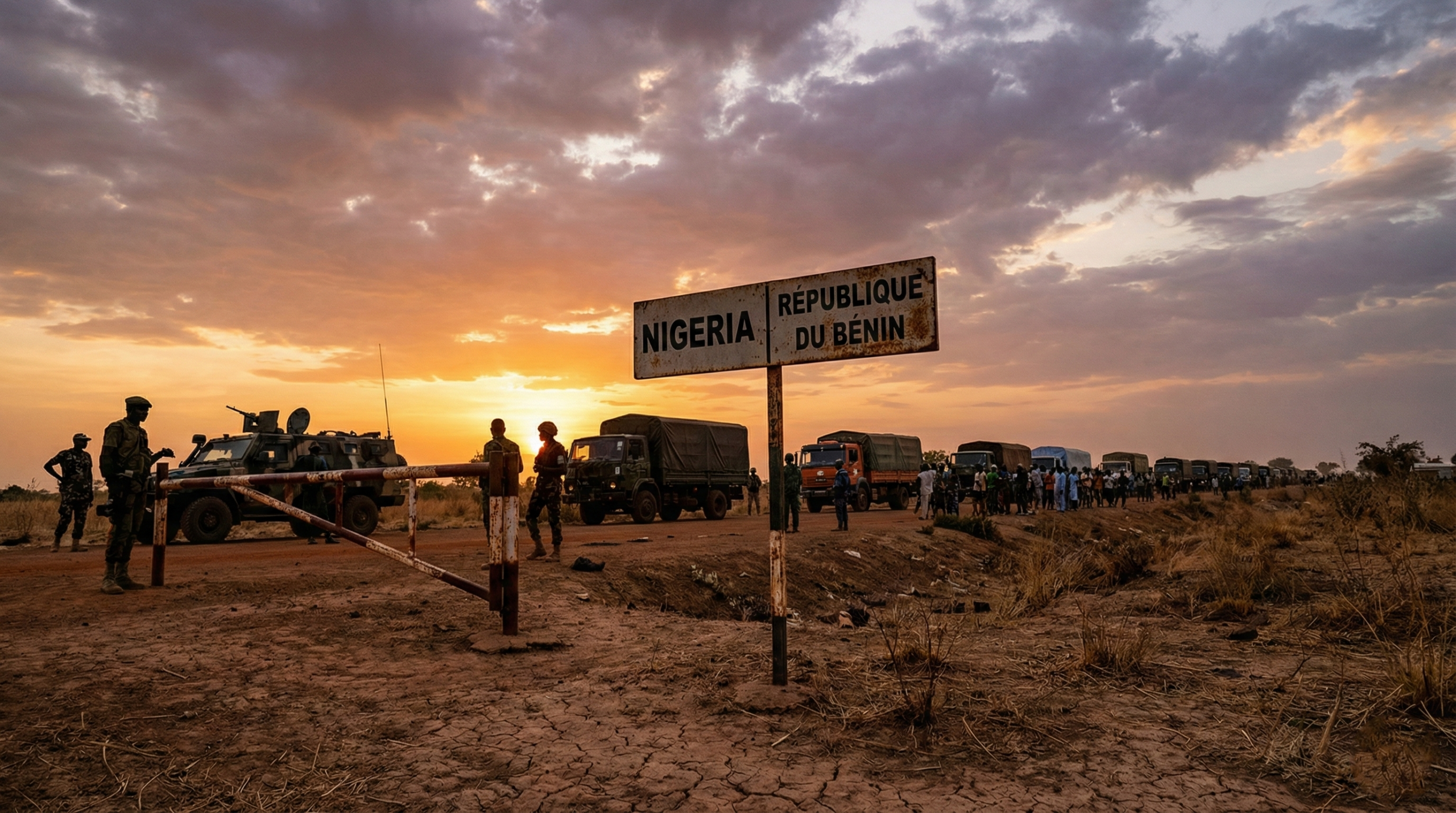
Nigeria-Cameroon Border Dispute: The Bakassi Peninsula Conflict Resolution

Nigeria-Cameroon Border Dispute: The Bakassi Peninsula Conflict Resolution

Read the full publication

13 Pages • PDF Download

Download PDF

AN ASSESSMENT OF TRANS-BOUNDARY CONFLICT BETWEEN NIGERIA AND

CAMEROUN: THE BAKASSI PENINSULA PERSPECTIVE.

Dr. Stephen Lazi Akhere

Petroleum Product Pricing Regulatory Agency (PPPRA)

ABSTRACT:

This paper accessed the implications of the Bakassi conflict settlement between Cameroon and Nigeria for sustainable

peace and economic development and examined the geopolitics of the Bakassi dispute. it discussed the implications

of the Bakassi conflict resolution for socio-economic development and international conflict resolution.

The colonial powers subjugated and divided Africa disregarding the relationship between territorial boundaries and

the anthropogenic homogeneity and/or characteristics of the various ethnic groupings. International conflicts we re

depicted as being shaped by: the nature and size of the booty that would accrue from the conflict, the nature of the

relationship between the social classes that constitute the main actors in the conflict, and the nature of domestic

politics in nation-states that form the bases for the contending parties.

The effective withdrawal of the Nigerian military, police and administration from Bakassi indicates that it is possible

for African countries in conflict to resolve matters amicably and avoid carnage, b lood-shed, socio -economic and

political dislocations, which many post-independent African nations have inflicted on themselves. Other things being

equal, the entire process leading to the final handing -over day is a model for the peaceful settlement of dis putes in

Africa. Reflections on the possible socio -economic implications of the Bakassi conflict resolution were anchored by

four aspects: expenditure -reducing and expenditure -switching effects of peaceful settlements; wealth -generating

effects of internat ional credibility; cross -border activities enhanced by confidence building; and the need for

accompanying measures to weaken sympathies for disruptive views propagated by negative social movements.

Data were derived from secondary sources and content analysis based on logical deduction and analysis of documents

was adopted. The study found out that the dominant causes of the conflict include geographical and constitutional

positions; colonial -legal sources, demographic, politico -strategic and economic issue s. It further reveals that the

Court resolutions on the conflict in favour of the Republic of Cameroun was informed by the colonial -legal sources,

as such, it provoked reactions from various segments of the Nigerian public including Bakassi indigenous population,

their paramount ruler, the Cross River State Youths Assembly and Nigerian Senate. But with the mediation of

UN/Secretary General between the two countries’ presidents, Bakassi territory was officially handed over to the

Camerounian Government. Hence demarcation between the two countries. Therefore, the study recommended among

others that to further strengthening Nigeria -Cameroun relations: Both countries governments should desist from

neglecting border areas, but encourage infrastructural developmen ts, effectively occupying of border ar eas to avoid

future incursions.

KEYWORDS: Conflict resolution, Reactions, Bakassi, Economic interest, International Court of Justice (ICJ)

INTRODUCTION

Bakassi is a peninsula on the Gulf of Guinea. It lies between the Cross River estuary, near the city of Calabar and the

Rio del Ray estuary on the east. It is governed by Cameroon, following the transfer of sovereignty from neighbouring

Nigeria as a result o f a judgment by the International Court of Justice . On 22 November 2007, the Nigerian Senate

rejected the transfer, since the Greentree Agreement ceding the area to Cameroon was contrary to Section 12(1) of the

1999 Constitution. Regardless, the territory was completely ceded to Cameroon on 14 August 2008, exactly two years

after the first part of it was transferred.

Territorial claims, ideology, colonialism, nationalism, religion and natural resources have typically been the main

sources of conflict throughout the world. While the influence of some of these is waning, struggles for the control of

valuable natural reso urces have remained a persistent feature of national and international affairs for decades. In

addition to helping some of the most corrupt and oppressive regimes to remain in power, natural resources have been

fuelling conflicts within and between African countries. Such conflict situations typically take the form of territorial

disputes over the possession of oil-laden border areas, factional struggles among the leaders of oil-rich countries, and

major inter-state wars over the control of vital oil and mineral zones (Klare 2004).

History

During the Scramble for Africa , Queen Victoria signed a Treaty of Protection with the King and Chiefs of Akwa

Akpa, known to Europeans as Old Calabar, on 10 September 1884. This enabled the British Empire to exercise control

over the entire territory around Calabar, including Bakassi. The territory subsequently became de facto part of Nigeria,

although the border was never permanently delineated. However, documents released by the Cameroonians, in parity

with that of the British and Germans, clearly places Bakassi under Cameroonian Territory as a consequence of colonial

era Anglo -German agreements. After Southern Cameroons voted in 1961 to leave Nigeria and became a part of

Cameroon, Bakassi remained under Calabar administration in Nigeria until ICJ judgement of 2002.

Population

Bakassi inhabitants are mainly the Oron people, the people of Cross River State and Akwa Ibom State of Nigeria.

Territorial dispute

Nigeria and Cameroon have disputed the possession of Bakassi for some years, leading to considerable tension

between the two countries. In 1981 the two countries went to the brink of war over Bakassi and another area around

Lake Chad, at the other end of the two countries’ common border. More armed clashes broke out in the early 1990s.

In response, Cameroon took the matter to the International Court of Justice (ICJ) on 29 March 1994.

The case was extremely complex, requiring the court to review diplomatic exchanges datin g back over 100 years.

Nigeria relied largely on Anglo -German correspondence dating from 1885 as well as treaties between the colonial

powers and the indigenous rulers in the area, particularly the 1884 Treaty of Protection. Cameroon pointed to the

Anglo-German treaty of 1913, which defined sphere of control in the region, as well as two agreements signed in the

1970s between Cameroon and Nigeria. These were the Yaoun dé II Declaration of 4 April 1971 and the Maroua

Declaration of 1 June 1975, which were devised to outline maritime boundaries between the two countries following

their independence. The line was drawn through the Cross River estuary to the west of the peninsula, thereby implying

Cameroonian ownership over Bakassi. However, Nigeria never ratified the agreement, while Cameroon regarded it as

being in force.

ICJ verdict

The ICJ delivered its judgment on 10 October 2002, finding (based principally on the Anglo-German agreements) that

sovereignty over Bakassi did indeed rest with Cameroon. It instructed Nigeria to transfer possession of the peninsula,

but did not require the inhabitants to move or to change their nationality. Cameroon was thus given a substantial

Nigerian population and was required to protect their rights, infrastructure and welfare.

The verdict caused consternation in Nigeria. It aroused vitriolic comments from Nigerian officials and the Nigerian

media alike. Chief Richard Akinjide, a former Nigerian Attorney -General and Minister of Justice who had been a

leading member of Nigeria’s legal team, described the decision as “50% international law and 50% international

politics”, “blatantly biased and unfair”, “a total disaster”, and a “comp lete fraud”. The Nigerian newspaper The

Guardian went further, declaring that the judgment was “a rape and unforeseen potential international conspiracy

against Nigerian territorial integrity and sovereignty” and “part of a Western ploy to foment and perpetuate trouble in

Africa”. The outcome of the con troversy was a de facto Nigerian refusal to withdraw its troops from Bakassi and

transfer sovereignty. The Nigerian government did not, however, openly reject the judgment but instead called for an

agreement that would provide “peace with honour, with the interest and welfare of our people.”

The ICJ judgement was backed up by the United Nations, whose charter potentially allowed sanctions or even the use

of force to enforce t he court’s ruling. Secretary-General Kofi Annan stepped in as a mediator and chaired a tripartit e

summit with the two countries’ presidents on 15 November 2002, which established a commission to facilitate the

peaceful implementation of the ICJ’s judgement. A further summit was held on 31 January 2004. This has made

significant progress, but the proc ess has been complicated by the opposition of Bakassi’s inhabitants to being

transferred to Cameroon.

Bakassian leaders threatened to seek independence if Nigeria renounced sovereignty. This secession was announced

on 9 July 2006, as the “Democratic Republic of Bakassi”. The decision was reportedly made at a meeting on 2 July

2006 and The Vanguard newspaper of Nigeria reported the decision to secede. The decision was reportedly made by

groups of militants including Southern Cameroons under the aegis of Southern Cameroons Peoples Organisation

(SCAPO), Bakassi Movement for Self -Determination (BAMOSD), and the Movement for the Emancipation of the

Niger Delta (MEND). Biafra separatist group, Biafra Nations League (BNL), initially known as Biafra Nations Youth

League led by Princewill Chimezie Richard aka. Prince Obuka and Ebuta Akor Takon (not the former Deputy, Ebuta

Ogar Takon) moved their operational base to the Peninsul a, after series of warning to Nigeria Government over the

plight of the internally displaced natives and the reported killing of remnants in the Peninsula by Cameroon Forces,

this came amid clashes between Nigeria Troops and Bakassi Strike Force, a Militan t Group that focused on attacking

Nigeria and Cameroon Forces, BnL Leaders were later apprehended in the Ikang -Cameroon Border Area on 9

November 2016 by Nigerian troops according to the Nigeria Nation Newspaper, reports linked the Biafra group to the

Militant groups. BnL have asked oil companies at the maritime boundary area of Bakassi Peninsula where Nigeria

and Cameroon drills oil to quit, the group also threatened to attack Cameroon Forces.

Resolution

On 13 June 2006, President Olusegun Obasanjo of Nigeria and President Paul Biya of Cameroon resolved the dispute

in talks led b y UN Secretary General Kofi Annan in New York City. Obasanjo agreed to withdraw Nigerian troops

within 60 days and to leave the territory completely in Cameroonian control within the next two years. Annan said,

“With today’s agreement on the Bakassi peninsula, a comprehensive resolution of the dispute is within our grasp. The

momentum achieved must be sustained.”

Nigerian withdrawal and low-level insurgency

Nigeria began to withdraw its forces, comprising some 3,000 troops, beginning 1 August 2006, and a ceremony on 14

August marked the formal handover of the northern part of the peninsula. The remainder st ayed under Nigerian civil

authority for two more years.

On 22 November 2007, the Nigerian Senate passed a resolution declaring that the withdrawal from the Bakassi

Peninsula was illegal. The government took no action, and handed the final parts of Bakassi over to Cameroon on 14

August 2008 as planned, but a Federal High Court had stated this should be delayed until all accommodations for

resettled Bakassians had been set tled; the government did not seem to plan to heed this court order, and set the

necessary mechanisms into motion to override it. Fishermen displaced from Bakassi were first settled in a landlocked

area called New Bakassi, which they claimed was already inhabited and not suitable for fishermen like them but only

for farmers. The displaced people were then moved to Akpabuyo, and eventually established a new community of

Dayspring.

Despite the formal handover of Bakassi by Nigeria to Cameroon in 2006, the territory of Bakassi is still reflected as

part of the 774 local governments in Nigeria as embodied in the First Schedule, Part I of the 1999 Constitution of the

Federal Republic of Nigeria, 1999. After the Nigerian 2015 General Elections, Nigeria’s 8th National Assembly still

accommodates the Calabar-South/Akpabuyo/Bakassi Federal Constituency represented by Hon. Essien Ekpeyong Ayi

of the People’s Democratic Party.

In the 2010s and 2020s, Biafran separatists, most importantly Biafra Nations League, still continue a low-level militant

resistance against Cameroon in regards to Bakassi.

The conflict between Nigeria and Cameroun over Bakassi peninsula, which the International Court of Justice (ICJ )

adjudicated, has eventually ceased, particularly the deployment of military forces by both countries. There is no doubt

that the conflict over the ownership of the Peninsula, an international boundary between Nigeria and her neigbour,

Cameroun, created a worrisome and confrontational demonstration of military vigor which almost escalated to war.

Hence, the conflict, while it lasted, attracted the attention of the international community as its escalation would have

threatened the lives and properties of N igerians and Camerounians as well as the global peace and security. Beseng

(2009:5) describes the situation that:

as the political wrangling over the right ownership of the Bakassi peninsula continued, military

tension was building up along opposite bord ers of peninsula. From May 1981 to November 2007,

there were different instances of severe military confrontations between Cameroun and Nigeria in

and around the peninsula. After one of such confrontations in February 1994 that resulted in severe

causalities and loss of life on both sides…the Camerounian government got tired and took legal

action 29th March, 1994 by filing a law suit against Nigeria in International Court of Justice (ICJ),

seeking a sanction for the expulsion of Nigerian force, which they said were occupying the territory

and to restrain Nigeria from laying claim to sovereignty over the peninsula.

Dispute settlement linkages between Cameroon and Nigeria

The conflict between Nigeria and Cameroon was a boundary and territorial dispute – the Bakassi Peninsula being the

most contested. Attempts were made in the past to resolve the dispute through bilateral negotiations, but in 1981, and

again in 1993, 1994 and 1996, the dispute nearly escalated to a war. Between 1994 and 2002, the matter was be fore

the International Court of Justice at The Hague. A judgment was pronounced in 2002 by the ICJ on the matter and the

Nigerian government issued a statement rejecting the verdict of the International Court. Yet following negotiations

between the two countries, facilitated by the UN and crowned by the June 2006 Green -tree Agreement in New York

and subsequent instruments, Nigeria completed the withdrawal of its military, administration and police from the

Bakassi Peninsula in August 2008. This has been des cribed as a remarkable outcome in conflict resolution in Africa.

However, it will be naïve to conclude that the issue has been neatly resolved without a careful examination of the

linkages propelling the conflict and resolution processes.

Statement of Problem

Bakassi peninsula is one of the boundary conflicts that attracted a lot of attention in African continent and International

community. Many had thought that the Nigerian Government and its Camerounian counterpart would not accept to

settle frontier problem due to the alleged values of the disputed area. Is it that those factors that cause the dispute are

not worthwhile to galvanise the Nigerian government into refusing to handover and opt for war again st Cameroun,

since before the Court decision, the military, police and administration of both countries were battle ready on both

sides of the Bakassi zone? What made the Nigerian public react against the decision of ICJ? It is important therefore

to examine the causes of this conflict as well as what compelled the Nigerian Government to give up on the fight over

Bakassi peninsula to embrace peace despite the alleged economic and strategic value of the peninsula. What many

countries in the world would not h ave let go, Nigeria did. It is on this note that this paper set out to appraise the

dominant causes of the boundary conflict between Nigeria and Cameroun particularly the Bakassi peninsula, how it

was resolved, the various reactions, as well as the role of the mediator in the management and implementation of

matters arising from the Court decision.

Objectives of the Study

The general objective of the study is to appraise the dominant causes of the boundary conflict between Nigeria and

Cameroun, particularly that of Bakassi peninsula. Nevertheless, the study has the following specific objectives:

i. To find out the dominant causes of the Bakassi peninsula conflict;

ii. To explain how the International Court of Justice (ICJ) resolved the conflict;

iii. To explore the reactions from various segments of the Nigerian public;

iv. To examine the important role of the international mediator i n the management and the

implementation of the Court decisions on the matter;

Research Questions

To achieve the above objectives, this study provides answers to the following questions:

i. What are the dominant causes of the Bakassi peninsula conflict?

ii. How did the International Court of Justice (ICJ) resolve the conflict?

iii. What are the reactions from various segments of the Nigerian public?

iv. What important roles did the mediator play in the management and implementation of the

Court decision?

Theoretical Framework

One of the most widely accepted approaches to explaining and understanding conflict in international relations is

realism or the realist theory. Realism prioritizes national interest and security, rather than ideals, social reconstructions,

or ethics. Realists believe that nations act only out of self -interest and that their major goal is to advance their own

positions of power. Realists believe that political struggle among humans is probably inevitable because people have

an inherent dark sid e. According to Thomas Hobbes (1588 -1679), one of the proponents of realism, human beings

possess an inherent urge to dominate, an animus dominandi. Hobbes argued in Leviathan published in 1951 that “if

any two men desire the same thing, which nevertheless they cannot both enjoy, they become enemies and…endeavour

to destroy or subdue one another.” Taking the same point of view, one leading realist scholar, Hans Morgenthau, wrote

that an “ubiquity of evil in human actions” inevitably turns revolutions into d ictatorships and lo ve of country into

imperialism”. Realists thinkers argued that leaders of nations use their power to advance the interests of their own

nations with little regard for morality or friendship. In order to survive, realists believe that lea ders must build their

power base and avoid feelings of friendship or morality that might make them vulnerable to more ruthless adversaries.

They also believe that conflict and war are inevitable. Accordingly, Waltz (1979:105) state that realists contend th at

the structure of the international system and the relative nature of power compels political leaders to view the world

in relative terms. According to realists, states worry that today’s friend may be tomorrow’s enemy in war, and fear

that achievements of joint gains that advantage a friend in the present might produce a more dangerous potential foe

in the future. As a result states must give serious attention to the gains of partners. Logically, there should be no

individual variation in beliefs because the anarchical structure of the international system drives behavior and this

structure is constant across time and space.

Based on the scholarly views of Machiavelli, realists contend that state officials are neither constrained by ethical

standards nor by known law of self-deprivation or self-abnegation as the idealists suggest, rather they often maximize

the gains of their countries. The underlying issue at stake in the relations among states is the maximization of national

power in order to increase national capability. To the realists, the central focus of international relations is the pursuit

of power, like other realist, argued that “…those that are not happy with the state of power distribution will seek to

augment their situation by seeking fo r change in the status quo so as to force change to maximize their power base.”

Morganthau believed that states get involved in power struggles to preserve the status quo, to achieve an expansionist

interest or to gain honour or prestige. He added that despite the existence of the League of Nations, the World War II

broke out because of the failure of nation states to compromise in the pursuit of their national interests. They believe

that sovereign states still pursue their national interests through any means available to them.

The propositions arising from the realist theory is suitable in explaining the simultaneous claims of ownership of

Bakassi peninsula by the Nigerian and Camerounian governments. The security -strategic value of the Peninsula was

discovered by the Nigerian government during the Nigerian civil war in 1966, when Cameroun government

provisionally authorized the Nigerian federal government to use portions of the Peninsula to block vital supplies to

the Biafran army. This partly explains the Nigerian Government’s claims over Bakassi peninsula, and the boldness of

Nigeria’s Federal Directorate of Surveys, backed by legal arguments formulated by the Federal Ministry of Justice, to

challenge the validity of the boundary agreements between Nigeria and Cameroun, especially the 1913 Anglo-German

Treaty and the Ahidjo-Gowon Agreement of 1975 (Ikome, 2004:22). The economic value of the Peninsula made the

Nigerian government ignore morality and friendship and forcefully set up her military and polic e administrations in

Bakassi to protect her national interest. In general, the fact that both states then viewed their common border as a

strong military division and as a defence line for promoting their exclusive national interests gives credit to the believe

by the realists that sovereign states still pursue their national interests through any means available to them.

METHOD AND DISCUSSIONS

The method of data collection adopted in this study was content analysis based on the logical deduction and analysis

of documents. Data were derived from secondary sources such as books, official documents journal articles and other

relevant articles on international relations, contending theories of international relations, Africa and the international

political system, conflict over natural resources in Bakassi, conflict, globalization and new resources wars,

Inviolability of Africa’s colonial boundaries conflict prevention, ICJ judgment, the handing over of Bakassi, among

others. Authors were acknowledged accordingly. Any research work that depends on secondary data should consider

the use of content analysis to systematically extract relevant ideas to i lluminate the subject matter. Thus, this study,

through the use of content analysis, extracted relevant ideas/information from secondary sources to provide answers

to the research questions. This method was adopted due to the nature of the research questio ns and it was adequate.

DOMINANT CAUSES OF CONFLICT BETWEEN NIGERIA AND CAMEROUN OVER BAKASSI

PENINSULA.

Diagnosing the causes of conflict is important in the search for solutions. Aristotle the founding father of Political

Science put it thus: ‘To kno w the causes which destroy constitutions is also to know the causes which ensure their

preservation.’ In other words, analysis of what causes conflict or violence is the first step for any policymaker who

would want to avoid them. The presumption here is t hat such analysis would be good and sound and helpful in the

choice (if not also in the initial design) of the most appropriate remedial measures for dealing with a given conflict.

To summarize the essence of the analogy borrowed from the medical field to the body politic: (i) a doctor cannot treat

an illness without proper diagnosis; (ii) the diagnosis must be correct and sound if the therapy prescribed is to prove

efficacious; and (iii) the therapy prescribed must suit the diagnosis made (Adekanye, 2007:1 71). Hence, this paper

followed similar approach in the appraisal of the dominant causes of boundary conflict between Nigeria and Cameroun

over Bakassi peninsula.

The Geographical and Constitutional Positions

Geographically, Bakassi peninsula is about 8 26.07 square kilometers, bordering Akpabuyo Council of Cross River

State, and Mbo Council in Akwa Ibom State, Nigerian international boundary with Cameroun. As figure 1 indicates,

the peninsula is situated between latitudes 4.26 and 4.5 degrees North of th e Equator, and longitudes 8.30 and 9.08

degrees East of Green which Meridian (Ajayi, 2002:11).

Figure 1: A map showing Bakassi area between Nigeria and Cameroun

Geography and economy

The peninsula lies between latitudes 4°25′ and 5°10′N and longitudes 8°20′ and 9°08′E . It consists of a number of

low-lying, largely mangrove covered islands covering an area of around 665 km2 (257 sq mi). The population of

Bakassi is the subject of some dispute, but is generally put at between 150,000 and 300,000 people.

Bakassi is situated at the extreme eastern end of the Gulf of Guinea, where the warm east -flowing Guinea Current

(called Aya Efiat in Efik) meets the cold north-flowing Benguela Current (called Aya Ubenekang in Efik). These two

ocean currents interact, creating huge foamy breakers which constantly advance towards the shore, and building

submarine shoals rich in fish, shrimps, and a wide variety of other marine life forms. Th is makes the Bakassi area a

very fertile fishing ground, comparable only to Newfoundland in North America and Scandinavia in Western Europe.

Most of the population make their living through fishing.

The peninsula is commonly described as “oil -rich”, though in fact no commercially viable deposits of oil have been

discovered. However, the a rea has aroused considerable interest from oil companies in the light of the discovery of

rich reserves of high grade crude oil in Nigeria. At least eight multinational oil companies ha ve participated in the

exploration of the peninsula and its offshore waters. In October 2012, China Petroleum & Chemical Corp oration

announced it had discovered new oil and gas resources in the Bakassi region.

Demographic Issues

According to Che (2007:15), the demographic composition of the border areas between Cameroun and Nigeria,

especially the oil -rich Bakassi peninsula, has been one of the dominant causes of the border dispute. In this regard,

Nigerian policy -makers have stated that the high concentration of Nigerians of Efik -Oron stock on the Bakassi

peninsula constitutes a special circumstance that warrants a renegotiation of its ownership. Drawing inspiration from

the British claims over the Falklands against those of Argentina, Nigeria has sought to legitimize their claims over

Bakassi on two grounds, namely: evidence of exclusive habitation, and evidence of continuous habitation by Nigerian

nationals. However, given Nigeria’s exploding population, Camerounian authorities have viewed the Nigerian

argument as a dangerous basis for the progressive ‘nigerianisation’ of Nigeria’s neighbouring states. For example, the

ever growing migrant Nigerian population in Cameroun was estimated at a little over 3 million in the early 1990s.

Moreover, Ikome (2004:20) added that there are areas, even in the heart of Camerounian cities, where people of

Nigerian descent were the majority. It therefore follows that if Nigeria were to use the concentration of her nationals

to lay claim to border areas, then eventually the same argument could be invoked to claim villages and towns of the

neighbouring states. This has been perceived as an attempt to extend Nigeria’s boundaries to all neighbouring

territories where there is a high concentration of Nigerian nationals and it is viewed as a form of ‘black imperialism’,

reminiscent of Hitler’s attempt to unite all the Germans into a singl e nation, which resulted in World War II. Hence,

there is no doubt that a country’s population constitutes part of his national power and Cameroun is disadvantage in

population compare with Nigeria. Cameroun authorities had renegotiate its ownership to cha nge the situation given

credence to what Morgenthau (1967:3) had said“…those that are not happy with the state of power distribution will

seek to augment their situation by seeking for change in the status quo so as to force change to maximize their powe r

base.”

Political developments and the Bakassi question

In May 1967, in response to the mandate granted to Lt. -Col. Ojukwu by the self -imposed Eastern Consultative

Assembly to secede, Lt.-Col. Gowon created 12 new states in Nigeria – including the South-Eastern State headed by

an Ibibio officer. The creation of the South -Eastern State from the former Eastern Region rekindled interest in

rejoining Nigeria among Efike and Ibibio residents of the Bakassi Peninsula – many of whom had actually voted in

1961 not to pursue integration with Nigeria. In July 1967, the Nigerian Civil War broke out and lasted until January

1970.

In April 1971, there was a summit meeting between General Gowon of Nigeria and Alhaji Ahmadou Ahidjo of

Cameroon in Yaoundé. It was at this meeting that Gowon and Ahidjo agreed to define the navigable channel of the

Akpa-Yafe River up to Point 12. During the summit, Ahidjo asked his survey expert to stop arguing and asked Gowon

to draw the line where he wanted it, and Gowon turned to his own t echnical expert for guidance. The expert marked

a point on the map and Gowon drew the line towards that point (Omoigui 2006). Unfortunately, the line Gowon drew

– on direct advice from the Director of Federal Surveys – was not the true navigable channel of the Akpa-Yafe River

as established by the colonial masters.

Two months later, in June 1971, the Joint Boundary Commission met in Lagos, led by Chief Coker for Nigeria and

Mr Ngo for Cameroon. They extended the already faulty Gowon -Ahidjo ‘compromise line ’ outwards to the sea in

what became known as the Coker-Ngo line. A few weeks later, following the signing of the Coker -Ngo line, Gowon

discovered what had transpired. In May 1972, the joint boundary commission met, followed in August 1972 by a

summit meet ing at Garoua, where General Gowon tried repeatedly without success to get Ahidjo to agree to the

reversal and renegotiation of the Gowon -Ahidjo/Coker-Ngo line. An oil rig was erected offshore by the Ahidjo

government in 1974, and later in June 1975 in a h ighly reluctant compromise to accommodate the rig, Gowon

conceded a tiny part of Nigerian maritime territory to Cameroon.

On 29 July 1975, General Gowon was overthrown in a coup d’état. The new regime decided to question the 1971 and

1975 Gowon-Ahidjo maritime agreements – either without really understanding the issues or by acting mischievously.

In no time the country got the impression that Gowon had given away the ‘Bakassi Peninsula’ to Cameroon to

compensate for President Ahidjo’s neutrality during the Nigerian Civil War, an unfortunate and totally false notion

which persists in many quarters to this day (Omoigui 2006). Many commentators still do not realise that the Peninsula

had been ceded by a series of actions and inactions beginning as far back as 1913, reconfirmed when Nigeria became

independent in 1960, finalised with the 1961 plebiscite and affirmed with the 1964 Organisation of African Unity

(OAU) declaration, which stipulated that independent African countries were bound to respect their co lonial borders

(Omoigui 2006).

HOW INTERNATIONAL COURT OF JUSTICE (ICJ) RESOLVED THE

CONFLICT.

On the 10th of October, 2002, the Court intervened and delivered its Judgment in the case concerning the Land and

Maritime Boundary dispute between Cam eroun and Nigeria (Cameroun v. Nigeria: Equatorial Guinea intervening

(Anekwe, 2002:1). In its Judgment, which was final and binding on the Parties, the Court determines the course of the

boundary, from North to South, between Cameroun and Nigeria. In the Lake Chad area, the Court:

decides that the boundary is delimited by the Thomson -Marchand Declaration of 1929 -1930, as

incorporated in the Henderson -Fleurinu Exchange of Notes of 1931 (between Great Britain and

France), it finds that the boundary starts in the lake from the Cameroun -Nigeria Chad tri -point

whose co-ordinates it defines) and follows a straight line to the mouth of the River Ebeji as it was in

1931 (whose co-ordinates it also defines) and thence runs in a straight line to between Lake Chad

and the Bakassi Peninsula, the Court decides that the boundary is delineated by the following

instruments: (i) From the point where the River Ebeji bifurcates, as far as Tamayar Peak, by the

ThomsonMarchand Declaration of 1929-1930, as incorporated in the HendersonFleuriau Exchange

of Notes of 1931; (ii) From Tamnyar Peak to pillar 64 referred to in Article XII of the Anglo-German

Agreement of 12th April 1913, by the British Order in Council of 2 th August 1946; (iii) From pillar

64 to the Bakassi Peninsula, by the Anglo-German Agreements of 11th March and 12th April 1913”

(ICJ Report, 2002:155).

In Bakassi, the Court decides that the boundary is delimited by the Anglo-German Agreement of 11th March 1913 and

that sovereignty over the Bakassi Peninsula lies w ith Cameroun. It decides that in this area the boundary follows the

mouth of the River Akpakorum (Akwayofe), dividing the Mangrove Islands near Ikang as far as a straight line joining

Bakassi Point and King Point (ICJ Report, 2002:156). As regards the maritime boundary, the Court, having established

that it has jurisdiction to address this aspect of the case – which Nigeria had disputed – fixes the course of the boundary

between the two States’ maritime areas (Anekwe, 2002:3). In paragraphs 314, 315 and 316 of its Judgment, the Court

requested Nigeria to expeditiously and without condition withdraw its administration and its military and police forces

from that area of Lake Chad which falls within Cameroun’s sovereignt y and from the Bakassi Peninsula. The Court

further decided that Cameroun:

is under an obligation military or police forces which may be present in areas along the land

boundary from Lake Chad to the Bakassi Peninsula which pursuant to the Judgment fall within the

sovereignty of Nigeria. Nigeria has the same obligation in regard to any administration or military

or police forces which may be present in areas along the land boundary from Lake Chad to the

Bakassi Peninsula which pursuant to the present Judgment fall within the sovereignty of Cameroun.

The Court takes note of Cameroun’s undertaking, given at the hearings, to continue to afford

protection to Nigerians living in the Bakassi peninsula and in the Lake Chad area…”(ICJ Report,

2002:152-153).

The ICJ’s judgment raises a number of important issues. One, two competing perspectives of sovereignty were

revealed – one historical (Nigeria’s) and one Western in origin (Cameroun’s). The fact that the ICJ relied on

‘Cameroun’s conventional titles’ indic ates that they gave precedence to contemporary Western constructions of the

notions of boundaries and sovereignty to the detriment of the historical consolidation argument put forward by the

Nigerian government. The argument of the Nigerian government turned on practice as opposed to theory, a perspective

that privileged the Bakassi indigenous population. However, in the reasoning of its Judgment, the Court further noted

that the implementation of the Judgment would afford the Parties a beneficial opportunity to co-operate in the interests

of the populations concerned, in order notably to enable them to continue to have access to educational and health

services comparable to those they currently enjoy. Such co -operation, the Court added, would be especially helpful,

with a view to maintaining security, during the withdrawal of the Nigerian administration and military and police

forces (Anekwe, 2002:3- 4).

The Green-tree Agreement

Following intense diplomatic offensives and the good office of the UN Secreta ry-General, Cameroon was able to

secure the Green-tree Agreement with Nigeria on June 12, 2006, brokered by the UN Secretary-General and witnessed

by Britain, France, Germany, and the Un ited States. Under the Agreement, the Nigerian troops were to withdraw

within a maximum of ninety days and a transition period of two years was given for the Nigerian administration to be

replaced by the Cameroonian administration. Nigerians living in the Peninsula would be able to remain there under a

special regime for four years after Cameroon takes full control and could stay on after that if they so wish.

According to the then Nigerian President Olusegun Obasanjo, the Green -tree Agreement was a great achievement in

conflict prevention, which practically reflected its cos t-effectiveness when compared with the alternative of conflict

resolution. He urged that it should represent a model for the resolution of similar conflicts in Africa and the world at

large. Moreover, President Obasanjo had played a leading role in conflict resolution among African states. His refusal

to respect the ICJ verdict would have left an unfavourable spot on his record. Meanwhile, his decision to respect the

ICJ verdict and withdraw Nigerian military forces from Bakassi met with strong opposition f rom some radicals, who

felt that Nigeria’s military might should be used for expansionist ambitions. In the same spirit with President Obasanjo,

President Paul Biya underscored the importance of respecting the ICJ ruling, arguing that their personal credib ility

and that of the UN depended greatly on its implementation and that it will begin a new era of trust, peace and

cooperation between Cameroon and Nigeria.

On 14 August 2006, the Nigerian troops, in a solemn ceremony, peacefully withdrew from the Bakass i Peninsula,

marking the climax of a long and meandering peace process that spanned a period of 12 years. The effective

withdrawal of Nigerian forces from Bakassi is an indication that it is possible for African nations who find themselves

in conflict over territorial rights and other issues to resolve the matter amicably – thus avoiding carnage, blood-shed,

socio-economic and political dislocations, which many post-independent African countries have suffered. Other things

being equal, the Green-tree Agreement and the various stages that led up to the handing over is a model for the peaceful

settlement of disputes in Africa. The entire process was graced by the Treaty of Calabar between Cameroon and

Nigeria on 14 August 2008 that marked the complete withdraw al of the Nigerian administration and police as

stipulated in the Green-tree Agreement.

Reaction of the Bakassi Paramount Ruler

Ighodaro (2008:1-2) reveals, in the Vanguard, Saturday 9th August, 2008, the reaction of the Bakassi paramount ruler,

Chief Etim Okon Edet who expressed the bitterness of the people of Bakassi Peninsular towards losing their fatherland

to Cameroun. According to Ighodaro, on 20 th June, 2008, when the Senate Joint Committee on Foreign Affairs,

Judiciary/Human Rights, States/Local Government Matters led by Prof. Jubril Aminu visited some Bakassi returnees

and other stakeholders in Calabar on account of the Bakassi question, the paramount ruler dismissed the visit of the

Senate committee because he consider the visit to inquire abo ut the Bakassi situation as very unnecessary. The

paramount ruler gave his reasons thus:

On 26th August, 2004, I wrote two letters to Kofi Annan and copied the Senate. On 13th June 2006, a

day after I heard about the Green -tree Agreement, I wrote anothe r letter to all Nigerians and the

National Assembly…. In all these, the Senate kept mute. Senators even said Obasanjo was right in

signing the Treaty. The Senate failed to rise to the occasion when it mattered most. It was only the

House of Representatives through Hon. Essien Ayi that rose to the occasion with a motion

unanimously passed by the House against the ceding (Ighodaro, 2008:2).

He, however, noted that since ICJ has given its judgment and the Green-tree Agreement had been signed, it was proper

for government to have made adequate preparations for the relocation of Bakassi indigenes. According to him:

The government, both at the national and state levels, has refused to talk to Bakassi people. We know

that there was a judgment in 2002 and we kn ew since then that the judgment has no appeal and the

Nigerian nation and the United Nations knew that sovereignty had been given to Cameroun and

eventually Bakassi people will leave. Nobody made any arrangement since then on the issue of

resettlement of Bakassi people. Few days to handing over, as has been reported, nobody has talked

to the paramount ruler of the place… (Akpan, 2006:2).

Reaction of the Cross River State Youths Assembly

Sama and Ross (2006:111 -112) reveals that the Cross River State You ths Assembly rejected the judgment in its

entirety. They issued a statement clearly defining their stand as follows:

  • We the Cross River State Youths reject completely the handover of Bakassi Peninsula to the Republic of

Cameroun because it lacked the consent and approval of the indigenous Bakassi people who are Nigerians;

  • The handing over of the ancestral land of Bakassi people to a foreign country did not follow due process because

it lacked the ratification of the National Assembly before the implementation by the presidency;

  • The Bakassi people refused to be transferred forcefully to a foreign country in the haste to obey a fraudulent world

court judgment;

  • Historically, other countries ar e known to have disobeyed the judgment of the world court including some

Western Nations.;

  • The ceding of Bakassi Peninsula was done without a referendum of the Bakassi people;
  • Nigerians cannot have their ancestral home transferred to a foreign land in obedience to a politicized world court

judgment;

  • Bakassi remains and will always remain part and parcel of Cross River State of Nigeria and not to be transferred

to the Republic of Cameroun because the inhabitants have no ancestral, historical, archaeologic al and political

links or ties. They are Nigerians and will always remain Nigerians;

  • We refused to be victims of neo-colonialist manipulations and machinations of the Western World all in obedience

to the World Court judgment. We the members of Cross Rive r State Youths Assembly are in solidarity with our

brothers and sisters of Bakassi origin and support their unwavering and unshakeable resolve to resist their

relocation to Republic of Cameroun.

Cross-border activities

Due to historical and ethno-linguistic ties between Cameroon and Nigeria, even during hostilities, trans-border trading

did not stop (Konings 2005). It is expected that with the peaceful handing over of Bakassi to Cameroon, fruitful socio-

economic activities between the two cou ntries will be revamped. In this regard, it will be in the interest of both

countries if more formal trading arrangements are negotiated, so as to curb smuggling, enhance the competitiveness

of home industries and increase tax revenues accordingly.

Cross-border activities will be enhanced further if Cameroon and Nigeria push forward their intentions to initiate a

number of political and economic confidence-building measures, and to consider the adoption of a treaty of friendship

and non -aggression between t hem. To crown it all, the Bakassi story illustrates the crucial role of multilateral

measures, such as the potential for dialogue and conflict resolution offered by recourse to the ICJ. The Mixed

Commission also represents a remarkable initiative and can b e seen as an excellent model for preventive diplomacy

and a precious tool for moving from a culture of confrontation to a culture of peace.

Notwithstanding this apparent success story in conflict settlement, a few months before 14 August 2008 – the date

Nigerian administration and police were expected to finally pull out from the Peninsula as per the June 2006 Green –

tree Agreement – a succession of armed attacks suggested that social movements were actively at work trying to

undermine the process. These att acks were perhaps meant to undermine the entire process of sustaining the peaceful

settlement. However, subsequent to the first attack, Nigeria dispatched a high-level government delegation led by the

Minister of State for Foreign Affairs to Yaoundé to pre sent the condolence of the government and people of Nigeria

following the brutal killing of Cameroonian Officers. In addition, Nigerian authorities stated and re-stated their resolve

to respect international commitments on the conflict settlement.

RECOMMENDATIONS

The study recommends ways in which the relationship between Nigeria -Cameroun could further be strengthened:

These include:

(i) Neglect of border areas by the governments of both countries contributed to the problem of border incursion.

Nigeria and Ca meroun new border policy should therefore, continue to provide for the construction of

schools, hospitals, roads, agricultural posts, telecommunications network, pipe -borne water and so on in the

area. It is perhaps only by carrying out infrastructural dev elopments and effectively occupying border areas

that future incursions can be checked and sustainable peace will be guaranteed between the two countries;

(ii) (both Nigeria and Cameroun governments should strictly abide by all diplomatic notes and agreements they

have or will exchange between each other now and in future, be it on border issues or other matters.

(iii) both Nigeria and Cameroun governments should be conversant with and committed to organizations

declaration, and ensure that the Organization of Afric an Unity (OAU) declaration, which stipulated that

independent African countries are bound to respect their inherited colonial borders, as commitment will help

prevent future invasion and violation;

(iv) National governments of both countries must learn to take prompt actions on the issues of resettlement of

displaced, as negligence could cause affected population to take negative actions that will truncate the peace

process;

(v) Any segment of the public that would be sympathizing, reacting or commenting when the ongoing boundary

demarcation is finalize between the two countries and officially announce, should be careful and mindful of

words/action capable of reawakening conflict situation as it may likely attract sanction and/or damage the

countries international image as well as hinder mutual relations.

(vi) Nigeria and Cameroun governments should ensure that the rights of the Bakassi displaced are protected as

slated in the Green Tree Agreement to avoid any problem that could emanate from violation of their rights

and threaten peace process;

(vii) As both countries have recognized the unproductive character of armed conflict and ceased fire, there is need

for a genuine desire and spirit from both sides of the Bakassi Peninsula to maintaining and sustaining the

present status quo. However, for the status quo to be maintained the Nigeria -Cameroun Mixed Commission

should be a permanent structure where concerns and problems arising from the management of the disputed

areas should be debated and resolved.

CONCLUSION

This paper has appraised the dominant causes of the boundary conflict between Nigeria Cameroun over Bakassi

peninsula, how the conflict was resolved by ICJ, reactions from the Nigeria public that almost escalate the problem

into war as well as the role of international mediator in the management and implementation of the Court decision in

the matter. Hence, as both countries has ceased from confrontational demonstration of military power over the

peninsula, they should fully take advantage of conflict resol ution to positively explore areas of possible cross -border

collaborations in the area of joint resource explorations and other common cross-border businesses that could benefits

their citizens including the displaced Bakassi indigenous populations. Better still, for the peaceful relationship between

Nigeria and Cameroun to further be strengthened, the above recommended should not be undermined, but taken

seriously. Generally, Nigeria and Cameroun peaceful conflict resolution should be seen as a model for all nations that

are still in military battle over conflicting national interest to drop their guns, negotiate, resolve for the sake of lives

and properties at risk and to give room for development as well as progress in the affected zone. The words of Nzeakah

cited in Anekwe (2002:8) is noteworthy here: war serves no one any good, for not only are both the victor and

vanquished practically equally bruised, exhausted and bloodied; with war, it may be futile to expect that what is

imposed or snatched will cea se to be a source of acrimony in the future…war by the two countries might have been

disastrous.

REFERENCES

Adekanye, B. J. (2007 ). Linking Conflict Diagnosis, Conflict Prevention, and Conflict

Management in Contemporary Africa: Selected Essays. Lagos: Ababa Press Ltd.

Ajayi, F. (2002). Bakassi Peninsula – Another Report Card of Military Misrule: We Need A

Referendum. Retrieved from http://nigeria world.com/columnist/ajayi/101802.html on 30th

May 2009.

Akpan, A. (2006). Emotions, worries as Nigeria hands over Bakassi Peninsula to Cameroun. The

Guardian. Retrieved from http://www. guardiannewsngr.com/weekend/article01/180806

on 1st April 2007.

Anekwe, C. M. (2002). ICJ Ruling on Bakassi: Matters Arising. Friday, December 27, 2002,

http://nigeriaworld.com/articles/2002/dec/273. html on 30th May 2009.

Beseng, U. M. (2009). From Conflict Over Natural Resources to Cooperation in Bakassi

Peninsula: A Success Story of Environmental Peacemaking and Peacebuilding? Retrieved

from: http:/www. africafiles.org/article.asp on 30th May 2009.

Che, N. K. (2007). Understanding The Bakassi Conflict: A Showcase of Conflict Prevention in

Practice. EPU Research Papers, pg 1-38.

Ighodaro, J. (2008). Emotions as Bakassi Goes to Cameroun Thursday! The Vanguard, Saturday,

09 August 2008 Retrieved from http:// www.vanguardngr.com/content/ view/13970/126/

on 23th Jan 2009.

Ikome, F. N. (2004). The Inviolability of Africa’s Colonial Boundaries: Lessons from the

Cameroon–Nigeria border conflict. Institute for Global Dialogue, Occasional Paper No 47,

Ed., Garth le Pere, Johannesburg South Africa.

Klare, M. T., (2004) Blood and oil: The dangers and consequences of America’s growing petroleum

dependency. New York: Holt.

Konings, P. (2005). The Anglophone Cameroon-Nigeria Boundary: Opportunities and Conflicts.

African Affairs, 104, 275-301. https://doi.org/10.1093/afraf/adi004

Omoigui, N. (2006). The Bakassi Story. Available from [Accessed

18 October 2010].

Sama, N.& Ross, B. (2006). Reclaiming the Bakassi Kingdom. Afrika Zamani, Nos. 13 & 14,

2005–2006. Retrieved from http://www. codesria.org/IMG/pdf/06_Sama_ Ross.pdf.

Waltz. 1979. Theory of international politics. Reading, MA: Addison-Wesley.

Leave a Reply

Your email address will not be published. Required fields are marked *

Back to top

Latest Podcast Episode

Listen to my latest podcast episode. Tap the play button listen!