Abstract
Africa remains a continent of paradox, where an abundance of natural energy resources exists alongside a persistent state of darkness. This study explores the historical evolution of global energy sources—from geothermal and hydro power to modern solar and urine-based research—and contrasts this progress with the chronic energy challenges facing African states. Focusing on Nigeria, the paper examines how corruption, poor leadership, and the “generator plant economy” stifle socioeconomic growth. It argues that overpopulation is not the root cause of underdevelopment, citing China and India as counter-examples, and concludes that decentralizing the national grid is the essential pathway to achieving stable power and technological advancement.
The Historical Quest for Light and Energy
Since the dawn of creation, light has been a prerequisite for socioeconomic growth and technological development. Most developed and developing economies invest heavily in energy sources to drive their daily activities. Throughout history, the world has invented diverse energy sources to enjoy uninterrupted power, beginning with geothermal energy used nearly 10,000 years ago and hydro energy, developed in the 18th century. Coal mining provided the earliest commercial source of heat and light in the mid-1700s.
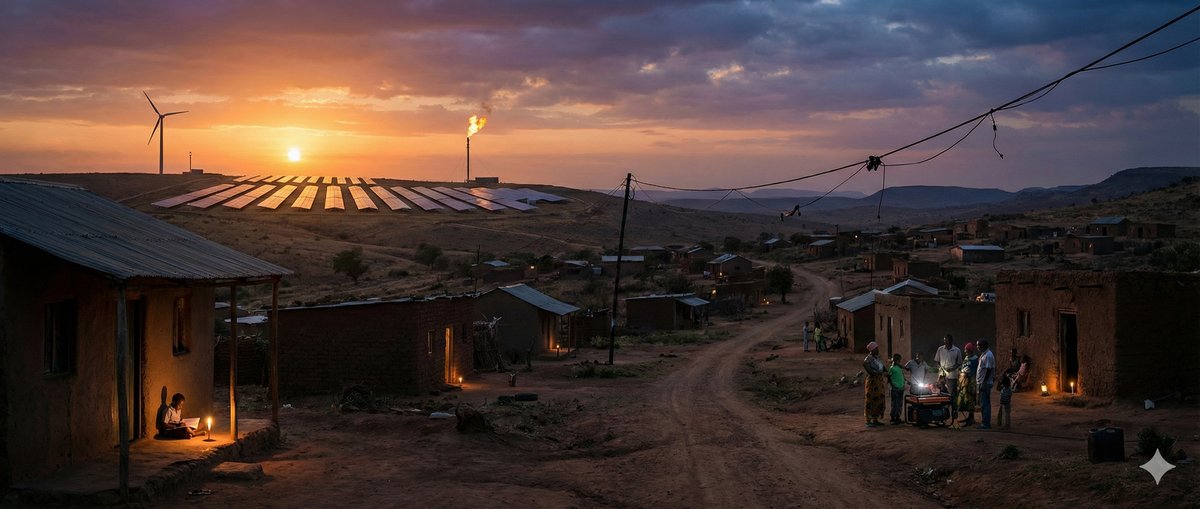
Innovation continued as the Egyptians harnessed wind energy as early as 5,000 BC to empower boats and pump water. The discovery of crude oil and gas in the 19th century further accelerated global technological advancement. In the 21st century, we have seen the emergence of solar energy, inverter technologies, and cutting-edge research into alternative sources like urine. While the world searches for cheap, clean, and affordable energy, many African states have stalled in finding lasting solutions to their epileptic energy challenges. This is particularly prominent among Black African nations, which are surrounded by natural energy endowments yet remain in a state of man-made darkness.
The Paradox of Poverty Amidst Plenty
It is a woeful anomie and a paradoxical irony to suffer in the midst of plenty due to ignorance, corruption, and greed. While some schools of thought argue that overpopulation causes Africa’s underdevelopment, history disputes this assumption. China and India, the most populous countries in the world, have achieved status as developed or rapidly developing nations. Overpopulation only becomes a challenge when there are no planned resources for human and material development.
While some African nations like Egypt, Libya, Algeria, and South Africa have made strides in their energy mix, the “generator plant economy” remains dominant in Sub-Saharan Africa, particularly in Nigeria. In this environment, private generators serve as the primary power source while the national grid remains a mere state antiquity, contributing nothing to the growth of the economy.
The Failure of Post-Independence Leadership
Nigeria is over 56 years post-independence, yet it has not found its footing in energy sustainability. While we often blame colonial history, we forget that freedom is a choice and development is the challenge that follows. Nations like the United States broke away from colonial methodologies to create a new social order, curriculum, and foreign policy. In contrast, Nigeria has struggled to harness its huge untapped human and mineral resources due to poor leadership and a lack of metaphysical vision.
Energy is the fundamental bedrock upon which industrialization, agriculture, education, and health revolve. In the pre-colonial era, lamps were strategically placed to eliminate darkness because it was recognized as repulsive and evil. Today, the presence of light indicates wealth and prosperity. As long as Africa remains in darkness, it is unlikely to see beyond its immediate struggles, as the lack of power energizes various forms of social vice and underdevelopment.
The “Generator Conspiracy” and Systemic Sabotage
There is a strong elitist conspiracy surrounding the importation of generating plants into Nigeria. While the government officially seeks power reforms, a small group of elites profits from the massive capital flight involved in the continuous importation of generators. This creates an environment where installation vandalism and policy sabotage become common. The downtrodden often act as “foot soldiers” for vandals due to survival instincts born of poverty, but the overarching issue is a social madness that must be cured through systematic reform.
Conclusion and Recommendations
To resolve the energy crisis, the Nigerian government must decentralize energy sources. Power generation and distribution should be moved to the States and the six geopolitical zones rather than relying on a centralized “National Grid.” This decentralization will allow for development without the encumbrance of a centralized, failing policy.
As a matter of policy urgency, the government must develop available alternative energy sources from the abundance of natural resources available. We must put the interest of the citizenry first, discarding the sentiments of religious or tribal affiliations in favor of merit and results. Light is a compulsory tool for development; no sphere of science or technology can function without efficient energy compliance. Nigeria must become a beacon of light for the African continent and the world at large.