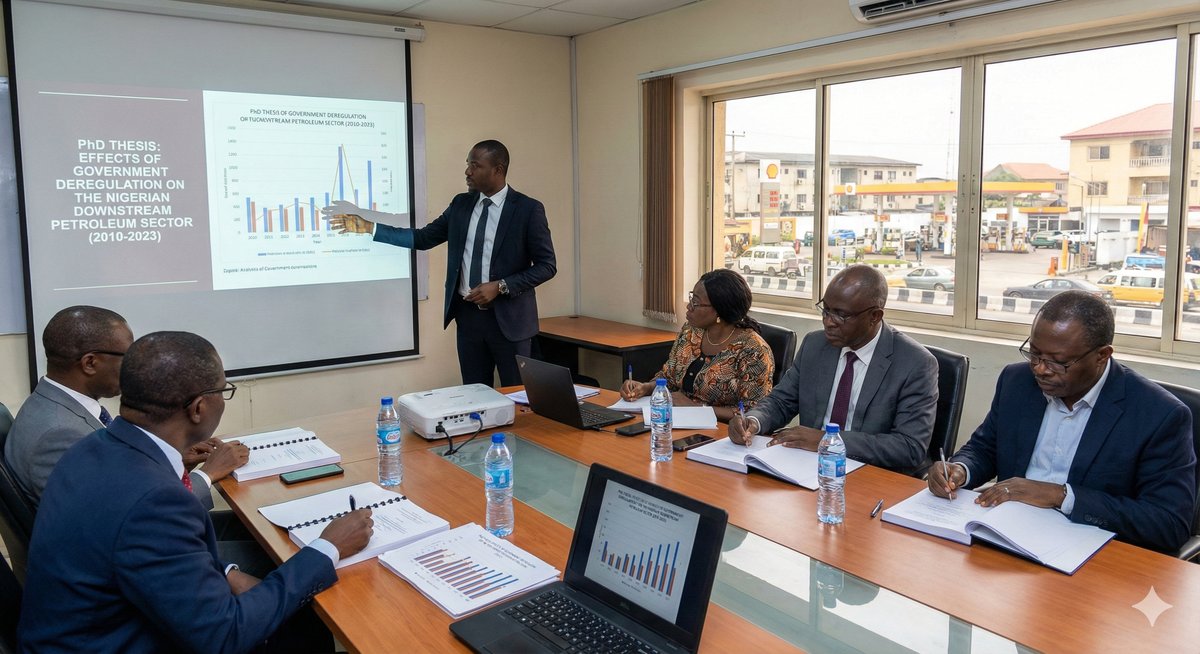
Abstract
The revolution in the Oil and Gas industry and availability of petroleum products to the final consumer now forms the mainstay of business activities in the downstream subsector in Nigeria. This sector contributes about 65-70 percent of the total socio-economic activities, acting as a major energy generator to all sectors of the economy. Deregulation policy of the downstream subsector is the action-plan of the government describing the intended objectives of improving petroleum supply and distribution networks. Notwithstanding the implementation of this policy, the nation is still confronted with unending problems occasioned by ineffectiveness of policy direction, low capacity utilization of local refineries, inadequate supply for local consumption, and price volatility.
This study examines the potential prospects for fundamental changes in the formation of the petroleum downstream subsector with Lagos State as a point of reference. Findings indicate that challenges facing the development of the sector are enormous. The study opines that for effective service delivery and economic transformation, the interest of the citizenry and their involvement must be prioritized. Above all, a broad-based deregulation devoid of monopoly would trigger economic industrialization in the country.
CHAPTER ONE: INTRODUCTION
1.1. Background to the Study
The dominance of oil in the global economic scene continues to engage the attention of both rich and poor nations alike. As an apparently industrialized commodity, it serves as the economic wheels of industrialization and will continue to generate heat in the world market for decades to come. Interest in Nigerian oil began following the amalgamation of 1914, specifically with a 1938 ordinance making any minerals under Nigerian soil the legal property of the Colonial Masters. Significant development in the petroleum sector emerged after the 1960s, a period when agriculture was the mainstay of the Nigerian economy, contributing over 70 percent of the Gross Domestic Product (GDP).
As of 2000, crude oil exports accounted for more than 98 percent of export earnings and about 83 percent of federal government revenue. It provides 95 percent of foreign exchange earnings and about 65 percent of budgetary revenues. Although the industry was founded at the beginning of the century, it was not until the end of the Nigerian Civil War (1967–1970) that the oil industry began to play a dominant role in the economic life of the country. Ironically, while Nigeria is the 7th largest exporter of crude oil, it maintains one of the highest poverty rates globally. Agriculture, once a dominant player, has been on a steady decline, now contributing less than 28 percent to the GDP.
Over the past forty years, the oil industry has contributed to employment, infrastructure, and foreign reserves. However, national development plans, such as the first seven-year plan (1962–1968), were often chequered by political instability. The 1970s saw a psyche shift in the average Nigerian due to the Udoji Commission’s review of public service pay, leading to a consumption habit based on oil wealth. This was followed by the Indigenization Decrees of 1974 and 1977, which sought to put the economy in the hands of Nigerians but led to significant divestment by foreign investors.
1.2. Statement of the Problem
Despite the strategic importance of oil and gas, the downstream subsector is characterized by ineffectiveness due to the long neglect of local refineries, sectoral corruption, and an obsolete legal framework. Nigeria remains an import-dependent economy, relying on western ideology and elites. It is pathetic that nations at par with Nigeria at independence in 1960, such as Malaysia, Ghana, and South Africa, have found their place as emerging market economies while Nigeria continues to slip.
Specific critical problems include:
- Low capacity utilization of state-owned refineries and petrochemical plants due to poor maintenance.
- Ineffective and inefficient government policy implementation.
- Price volatility resulting in protracted queues at filling stations.
- Illegal bunkering, cross-border smuggling, and hoarding.
- The heavy burden of subsidies on the national economy.
- The sorry state of logistic facilities (pipelines, depots, and jetties) due to vandalism across Lagos State.
1.3. Aims and Objectives of the Study
The primary aim of this research is to examine the effect of government deregulation policy on the petroleum downstream subsector of the economy of Nigeria. The objectives include:
- To verify and examine various policies in the downstream petroleum industry.
- To identify and examine policy issues on downstream deregulation.
- To evaluate the effects of the deregulation policy on the Nigerian economy.
- To assess the constraints in policy implementation.
- To examine the experiences of other countries regarding deregulation.
1.4. Research Questions
- Is the deregulation of the petroleum downstream subsector justified in terms of socio-political readiness?
- Is deregulation a catalyst for the repositioning of socio-economic development?
- Is there uniform pump pricing across the country in the current regulatory system?
- What role does the government play in ensuring the actualization of deregulation?
- Could existing refineries be improved to meet demand challenges?
1.5. Research Propositions
The following propositions guide this work:
- The deregulation policy has not yet impacted positively on the petroleum downstream subsector and the economy at large.
- Strategies to make products available and achieve price stability have not been effective.
- The measures taken to make the subsector competitive have not met objectives because the NNPC still monopolizes the sector.
- Subsidization stagnates holistic development as only a few individuals benefit at the expense of the larger population.
1.6. Significance of the Study
This research work is tasking as it borders on national and international issues beneficial to political economy scholars and government apparatus. Since the return to democracy in 1999, the policy thrust has favored market-based approaches like Import Price Parity (IPP). However, implementation has often led to general strikes and industrial actions organized by labor coalitions, costing the economy incalculable losses in man-hours.
1.7. Scope of the Study
The study assesses the impact of the deregulation policy on national development with a special reference to Lagos State between 1999 and 2007. This period was selected due to data availability and socio-political expediency. It examines changes in the sector, the role of the elite class, the influence of the Western bloc, and the monopoly of the NNPC.
1.7.1. The Study Area: Nigeria and Lagos State
Nigeria has a landmass of 923,769 km² and is characterized by a strong climatological gradient. Lagos State, created on May 27, 1967, serves as the nation’s economic and commercial capital. It is the nation’s largest urban area and a socio-cultural melting pot. Despite being the smallest state by landmass, it is arguably the most economically important.
Map 1: Nigeria indicating States
Refer to page 33 of the original document for the full state map.
Map 2: Lagos State Administrative Divisions
Refer to page 34 for the detailed map of Ikeja, Badagry, Ikorodu, Lagos Island, and Epe divisions.
1.7.2. Refineries in Nigeria
There are four state-owned refineries in Nigeria with an initial combined capacity of 445,000 barrels per day (bpd):
- Port Harcourt I: Commissioned 1965 (60,000 bpd).
- Warri: Commissioned 1978 (125,000 bpd).
- Kaduna: Commissioned 1980 (110,000 bpd).
- Port Harcourt II: Commissioned 1989 (150,000 bpd).
Currently, capacity utilization is abysmal. These facilities were largely abandoned during the military era, skipping mandatory turnaround maintenance (TAM), which made product importation inevitable.
Refinery Infrastructure Photos
See pages 38-40 for pictorial representations of Kaduna Petrochemical, Warri Offshore, and the Pipeline Network.
1.7.3. Pipeline Network and Distribution
Nigeria utilizes a 5,001 km pipeline network to move products to 21 storage depots. Key systems include:
- System 2A: Warri-Benin-Ore-Mosimi
- System 2B: Atlas Cove-Mosimi-Ibadan-Ilorin (serving Ejigbo in Lagos)
- System 2C: Escravos-Warri-Kaduna
The network is aging; while pipelines have a 50-year lifespan, many are deteriorating due to lack of maintenance and deliberate acts of vandalization.
1.8. Distribution and Retail Outlets
Prior to independence, distribution was managed by Ocean Oil Company. Post-independence, the Nigerian National Oil Company (NNOC) was formed in 1971, later becoming the NNPC in 1977. Lagos State alone captured between 4,000 and 5,000 filling stations in the 2006/2007 census.
Table 1: Holding Capacity of Petroleum Depots (Figures in M³)
| Depot Location | PMS (Petrol) | DPK (Kerosene) | AGO (Diesel) |
|---|---|---|---|
| Mosinmi | 163,400 | 76,000 | 127,200 |
| Ibadan | 102,800 | 28,700 | 40,500 |
| Kaduna | 135,000 | 65,000 | 97,000 |
| Port Harcourt | 145,000 | 93,000 | 141,000 |
1.9. Methodological Challenges and Limitations
Restricting the scope to Lagos State presents constraints, primarily the subjectivity and bias of respondents in filling questionnaires. Some stakeholders felt reluctant to cooperate. However, secondary data sources from the Central Bank of Nigeria (CBN) and the NNPC helped bridge the gaps in this research.