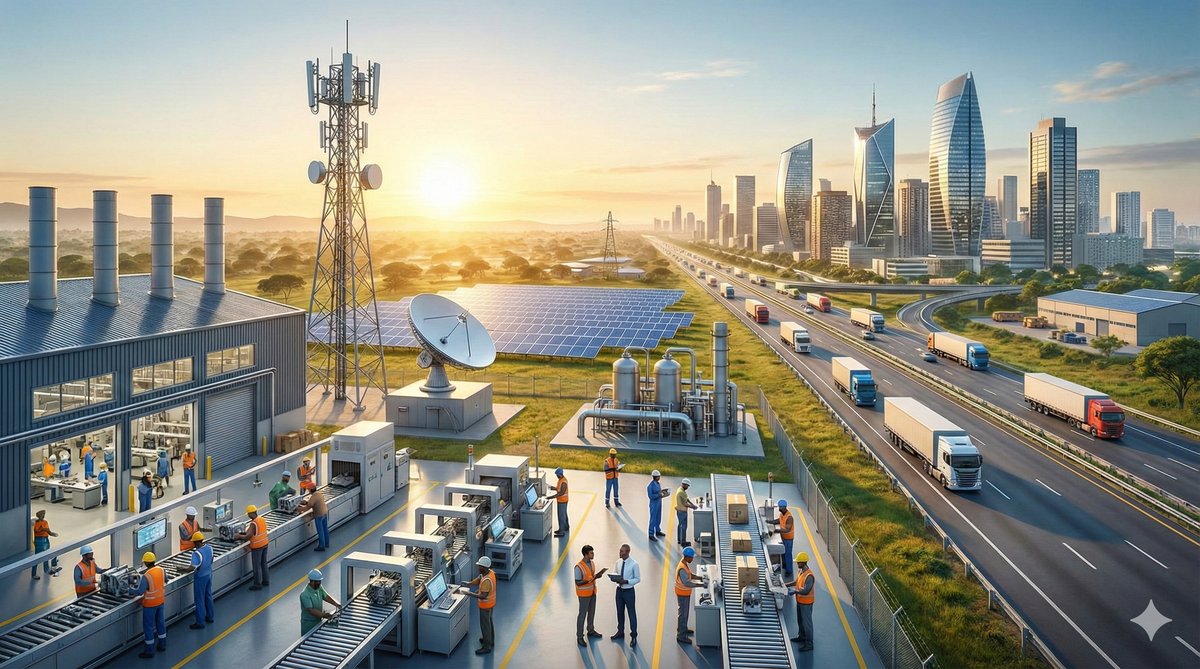
THE EVOLUTION OF INDUSTRIALIZATION
Pre-industrial revolution started in the 16th – 19th centuries in Europe and America, with improvement of standard of living of their citizens through agricultural boom, cultivated by slaves. Some pre-industrial economies like classical Athens, Roman civilization, and the medieval Islamic (caliphate) states were all able to source for better standard of living for their people through agriculture.
However, developed economies such as the United Kingdom, America, France, Germany, Russia, and the Asian Tigers had their take-off stages of industrialization from agriculture and commerce. This dispensation facilitated unprecedented population growth with equilibrium workforce in farming to harness the existing economic potentials that triggered developmental growth.
Industrialization simply means imploring scientific methodology in human and material resources for the socio-economic benefit of a nation. This new discovery implies a radical change that brings an improvement in the standard of living of citizens. Thus, the aforementioned countries have been able to seize this opportunity of scientific research to better the lives of their citizens and subsequently position themselves on the global map.
Having said that, Africa (Egyptian civilization) was the cradle of civilization dating back from the 14th to 15th century. By implication, Egypt experienced agricultural revolution before the Western world did. The accumulation of capital allowed for stronger agricultural investment in scientific core areas of technology to dominate the world economy, enabling industrialization in other countries like Hungary, Austria, Poland, and many other European countries to move upward in the 1880s.
INDUSTRIALIZATION IN AFRICA
Most African countries did not follow the footprint of Egypt. They rather relied on poor farming systems that could barely feed more than three families. Although there was a resemblance of governance for most African states, this governance was not knowledgeable enough to drive the concept of development through agriculture that could have been the platform for industrialization. During the pre-colonial state of Africa, we prided ourselves in peasant farming before the coming of colonial masters who divided Africans within Western colonies of their choice.
The first industrialization that took place in Africa was on arable agricultural produce driven by colonial commerce in exchange for slaves and cowries as a medium of exchange. The abrogation of slave trade by the United States Federal Law (The Act Prohibiting Importation of Slaves) in 1807, which took effect in 1808, gave Africa leverage for looking toward the emancipation from past setbacks resulting from continental abuse.
Africa started looking toward economic and technological empowerment at the instance of the colonial masters who imposed their own foreign business and political ideologies. This led to another delay in the development of the continent. During the colonial era, Africa, under the supervision of the Western world, started imbibing cultural imperialism in the areas of commerce, technology, manual skill acquisition, education, and language. While advanced skills in technology were kept from their reach, Africa moved forward fairly in power, construction, and economy.
CONTEMPORARY CHALLENGES AND JOB CREATION
In the 21st century, Nigeria, South Africa, Angola, and other potential African states are on the road path to industrialization. While Western states are gradually migrating to the continent of Africa to harness her investment potential, Africa still remains a fertile continent for massive technological advancement if priority is given to economic policies that will wheel growth.
In the late 1990s and early 2000s, Nigeria created economic platforms for entrepreneurial revolution. The opening up of the petroleum sector, the deregulation of telecommunications, and the establishment of the NigComSat satellite were milestones that empowered Small and Medium Scale Enterprises (SMEs) and bridged unemployment gaps. However, Africa remains grossly under-industrialized relative to its workable age bracket. Industrialization is a factor of qualitative research on science, technology, and entrepreneurial development with a proven marketing mix.
Another booster to industrialization is adequate and constant energy supply, which most African countries have not been able to overcome. The theory of sentiment by African leaders has often hampered industrialization. A nation is said to be underdeveloped when there is a total absence of the rule of law, poor leadership style, and octopus policies without equilibrium drive to achieve them.
CONCLUSION
The current investment in Nigerian oil and gas, coupled with sectorial reform and the resuscitation of the agricultural sector, will massively generate employment when completed. Industrialization is not only an aged form of a New Global Order; rather, it is an economic engine that energizes wealth for socio-structural development and broad economic empowerment.
A positive impact of industrialization on any economy is the improvement of disposable income. This implies a free flow of wealth among citizens, which will reduce inflation and eliminate high unemployment ratios. When this happens, Africa will be able to compete in the long run with the industrialization matrix, forcing every socio-economic and political index to automate itself into massive development. Industrialization will enhance modern challenges such as changes in lifestyle, educational improvement, and urbanized transportation systems, which are the hallmarks of socio-economic advancement.